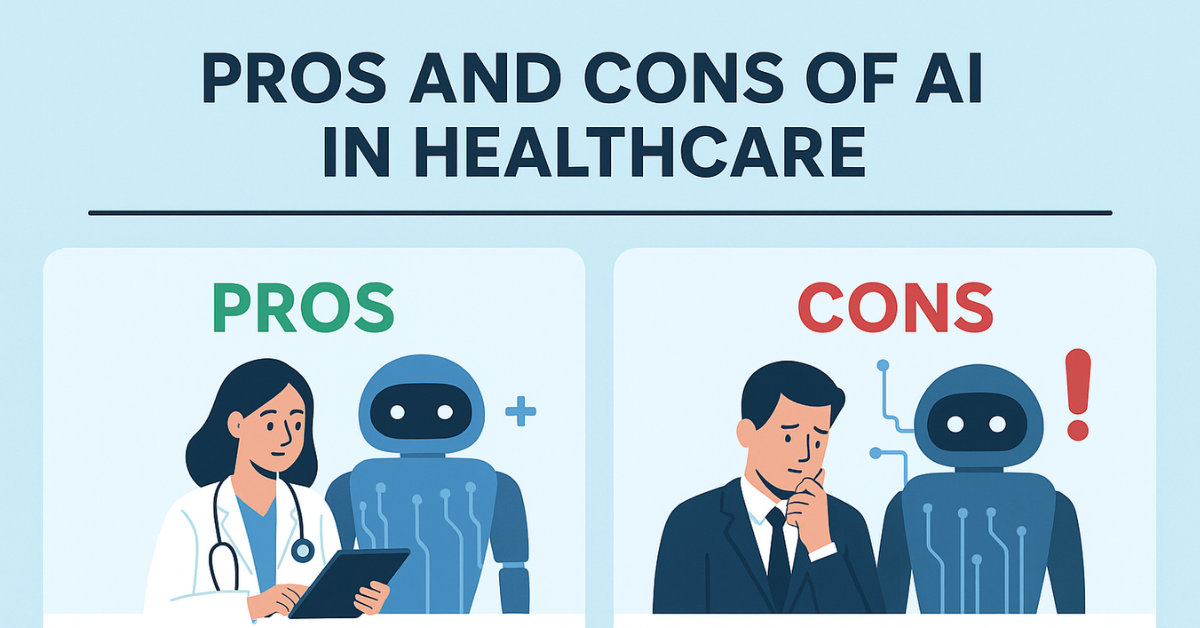
Artificial Intelligence (AI) is transforming almost every sector, and healthcare is one of the biggest beneficiaries. From early disease detection to robotic surgery, AI is helping doctors deliver faster, more accurate, and more personalized care.
But like every technology, AI also comes with limitations, risks, and ethical concerns.
In this blog, we will break down the pros and cons of AI in healthcare, explain how it works, and discuss what the future may look like.
⭐ What is AI in Healthcare?
AI in healthcare refers to the use of artificial intelligence technologies—like machine learning, deep learning, natural language processing, and robotics—to improve patient care, diagnosis, treatment planning, and administrative tasks.
✅ Pros of AI in Healthcare
1. Faster and More Accurate Diagnosis
AI algorithms can analyze thousands of medical images and detect abnormalities that human eyes may miss.
Highlighted Point:
➡️ AI tools can achieve diagnostic accuracy comparable to, and sometimes better than, expert doctors.
Examples:
- Detecting cancer from CT/MRI scans
- Identifying diabetic retinopathy
- Predicting heart disease risk
2. Reduces Human Errors
Medical errors are a major cause of complications. AI provides data-driven recommendations, reducing the chances of misdiagnosis, incorrect dosage, or wrong treatment.
3. Improves Treatment Personalization
AI can process huge datasets to recommend personalized treatment plans based on a patient’s unique medical history, genetics, and lifestyle.
Highlighted Point:
➡️ Personalized care increases treatment success rates.
4. Enhances Medical Imaging
AI-powered imaging tools improve image clarity, detect anomalies early, and help radiologists interpret scans more efficiently.
5. Automation of Administrative Tasks
AI helps hospitals with:
- Patient scheduling
- Billing
- Electronic health record (EHR) management
- Insurance claim processing
This saves time and reduces the workload on healthcare staff.
6. Support in Surgery (Robotic & AI-Assisted)
AI-guided robots help perform minimally invasive surgeries with high precision.
7. Early Detection and Prevention
AI can analyze wearables and health apps to identify early warning signs before they turn into serious diseases.
❌ Cons of AI in Healthcare
1. High Initial Cost
Implementing AI systems in hospitals requires expensive equipment, software, and training.
2. Data Privacy Risks
AI systems rely on sensitive patient data.
If not protected properly, this can lead to data leaks, hacking, or misuse.
Highlighted Point:
➡️ Privacy and cybersecurity are major concerns in AI healthcare applications.
3. Lack of Human Touch
AI cannot replace empathy, emotional care, and human judgment, which are essential in patient treatment.
4. Risk of Misdiagnosis
AI predictions depend on the quality of data used to train the models.
Poor quality or biased data can lead to inaccurate results and potential harm.
5. Large Dependency on Technology
Hospitals may become overly reliant on AI, leading to challenges if systems fail or malfunction.
6. Ethical and Legal Issues
Some key concerns include:
- Who is responsible if AI makes a mistake?
- How much decision-making power should AI have?
- Should AI replace some healthcare jobs?
7. Limited Adoption in Rural Areas
Developing countries face challenges such as:
- Limited internet connectivity
- Lack of skilled technicians
- High cost of AI equipment
🔥 Key Highlighted Points
- AI improves speed, accuracy, and efficiency in healthcare.
- AI cannot replace doctors but can support them in decision-making.
- Data privacy and ethical issues remain major challenges.
- The future of healthcare will be a collaboration between humans and AI, not a replacement.
❓ Frequently Asked Questions (FAQ)
1. What is the main advantage of AI in healthcare?
AI offers faster and more accurate diagnosis, helping detect diseases early and improving patient outcomes.
2. Can AI replace doctors in the future?
No. AI can assist doctors by analyzing data and suggesting treatment options, but human judgment and empathy are irreplaceable.
3. Is AI safe to use in medical diagnosis?
AI is generally safe when trained with high-quality data and used with human supervision. However, errors can occur if the system is not properly monitored.
4. What are the biggest challenges of AI in healthcare?
The main challenges are:
- Data privacy issues
- High cost
- Lack of skilled staff
- Ethical and legal concerns
5. How is AI used in hospitals today?
AI is used for:
- Medical imaging
- Disease prediction
- Robotic surgery
- Administrative automation
- Drug discovery
6. Is AI affordable for all hospitals?
Large hospitals may adopt AI easily, but smaller or rural hospitals may find it expensive due to high setup and training costs.
7. What is the future of AI in healthcare?
AI will improve personalized medicine, reduce workload on doctors, and enable faster diagnosis. The future will involve AI + human collaboration.
Latest Post
- World Oral Health Day 2026: Importance of Oral Hygiene for a Healthy Life
- Posterior Hip Dislocation: Causes, Symptoms & Treatment
- Dog Dislocated Hip: Symptoms, Treatment & Care
- Dislocated Hip Symptoms: Early Signs, Pain Patterns, and When to Seek Medical Help
- ICD 10 Code for Benign Prostatic Hypertrophy: Complete Coding & Clinical Guide