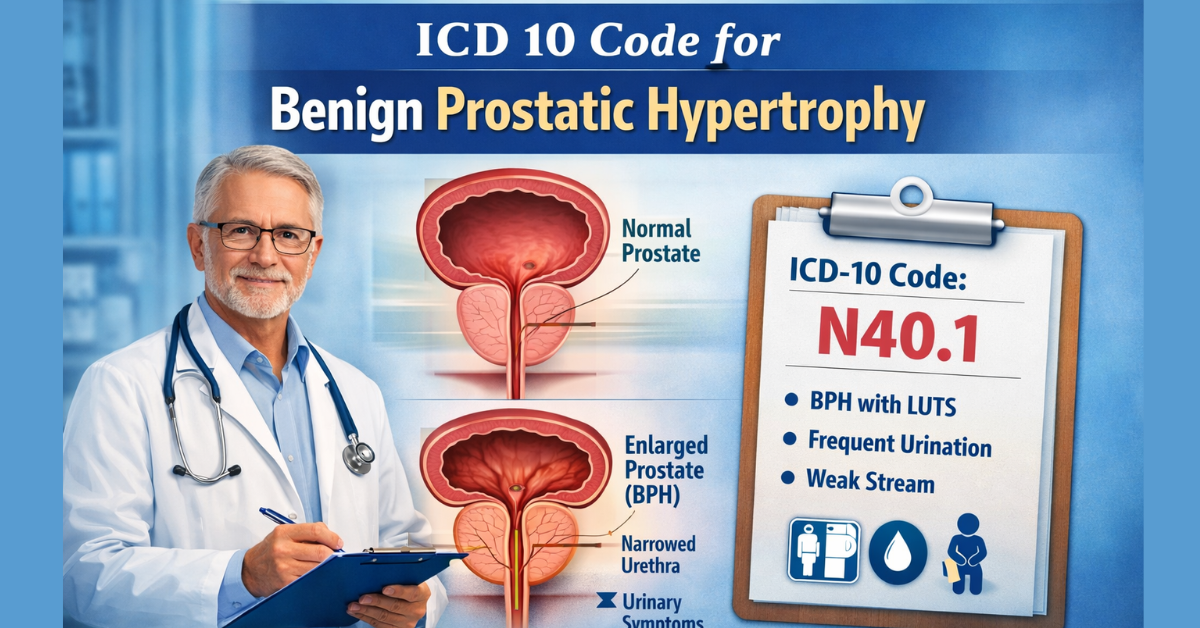
Benign Prostatic Hypertrophy (BPH), also known as benign prostatic hyperplasia, is one of the most common urological conditions affecting aging men. Accurate medical coding is essential for diagnosis documentation, insurance claims, hospital records, and epidemiological studies. The ICD 10 code for benign prostatic hypertrophy plays a vital role in ensuring standardized healthcare communication across systems.
In this detailed guide, we will explain the ICD 10 code for BPH, its subcategories, related conditions, clinical significance, billing importance, and frequently asked questions. This article is especially useful for healthcare professionals, medical coders, students, and healthcare bloggers
What Is Benign Prostatic Hypertrophy?
Benign Prostatic Hypertrophy (BPH) is a non-cancerous enlargement of the prostate gland that commonly occurs in men over the age of 50. The prostate surrounds the urethra, and when it enlarges, it can cause urinary obstruction and lower urinary tract symptoms (LUTS).
Common Symptoms of BPH
- Frequent urination (especially at night)
- Weak urine stream
- Difficulty starting urination
- Incomplete bladder emptying
- Urgency to urinate
- Dribbling at the end of urination
While BPH is not life-threatening, it can significantly impact quality of life if left untreated.
ICD 10 Code for Benign Prostatic Hypertrophy
The ICD 10 code for benign prostatic hypertrophy falls under the N40 category in the International Classification of Diseases, 10th Revision (ICD-10-CM).
Primary ICD 10 Code for Benign Prostatic Hypertrophy
N40 – Benign prostatic hyperplasia
This is the base ICD 10 code for benign prostatic hypertrophy and is further divided into more specific codes based on associated symptoms or complications.
Detailed ICD 10 Codes for Benign Prostatic Hypertrophy
Below are the commonly used ICD 10 codes related to benign prostatic hypertrophy:
🔹 N40.0 – Benign prostatic hyperplasia without lower urinary tract symptoms
- Used when BPH is diagnosed but no urinary symptoms are present.
🔹 N40.1 – Benign prostatic hyperplasia with lower urinary tract symptoms
- This is the most frequently used ICD 10 code for benign prostatic hypertrophy.
- Used when BPH is associated with LUTS such as urinary frequency, urgency, or weak stream.
🔹 N40.2 – Benign prostatic hyperplasia with lower urinary tract symptoms and obstruction
- Used when BPH causes urinary obstruction or retention.
🔹 N40.3 – Benign prostatic hyperplasia with urinary obstruction
- Applies when obstruction is documented without specific LUTS coding.
🔹 N40.9 – Benign prostatic hyperplasia, unspecified
- Used when documentation is insufficient to assign a more specific ICD 10 code for benign prostatic hypertrophy.
Why the ICD 10 Code for Benign Prostatic Hypertrophy Is Important
Using the correct ICD 10 code for benign prostatic hypertrophy is essential for several reasons:
1. Accurate Medical Documentation
Proper coding ensures the patient’s diagnosis is clearly documented in medical records.
2. Insurance & Billing Purposes
Insurance reimbursement depends on accurate ICD 10 coding. Incorrect use of the ICD 10 code for benign prostatic hypertrophy can result in claim denials.
3. Clinical Decision Making
Specific codes help physicians track disease progression and treatment outcomes.
4. Public Health & Research
Data collected using the ICD 10 code for benign prostatic hypertrophy supports research and healthcare planning.
ICD 10 Code for Benign Prostatic Hypertrophy vs Prostate Cancer
It is important to differentiate between benign and malignant prostate conditions:
| Condition | ICD 10 Code |
|---|---|
| Benign Prostatic Hypertrophy | N40 series |
| Malignant Neoplasm of Prostate | C61 |
Using the wrong ICD 10 code for benign prostatic hypertrophy can lead to serious clinical and billing errors.
Common Conditions Associated with BPH (Additional Codes)
Sometimes BPH is documented along with other urinary conditions:
- R33.8 – Other retention of urine
- N39.0 – Urinary tract infection
- R35.1 – Nocturia
- R39.12 – Weak urine stream
These may be coded in addition to the ICD 10 code for benign prostatic hypertrophy when clinically relevant.
Tips for Correct ICD 10 Coding of Benign Prostatic Hypertrophy
- Always check for lower urinary tract symptoms
- Review clinical notes for urinary obstruction or retention
- Avoid using N40.9 if more details are available
- Code additional symptoms separately when required
- Follow payer-specific coding guidelines
FAQs :-
1) What is the most commonly used ICD 10 code for benign prostatic hypertrophy?
N40.1 – Benign prostatic hyperplasia with lower urinary tract symptoms is the most commonly used ICD 10 code for benign prostatic hypertrophy.
2) Is BPH the same as benign prostatic hypertrophy?
Yes, benign prostatic hypertrophy and benign prostatic hyperplasia refer to the same condition in ICD 10 coding.
3) Can multiple ICD 10 codes be used with BPH?
Yes, additional codes for urinary symptoms or complications can be used along with the ICD 10 code for benign prostatic hypertrophy.
4) Does the ICD 10 code for benign prostatic hypertrophy include prostate enlargement only?
The code includes prostate enlargement and related urinary symptoms, depending on the subcategory used.
5) Is BPH a cancerous condition?
No, BPH is a non-cancerous condition and should never be coded under malignant neoplasm codes.
Conclusion
The ICD 10 code for benign prostatic hypertrophy is an essential part of modern medical documentation and healthcare billing. The N40 category provides detailed subcodes that accurately describe the presence or absence of urinary symptoms and obstruction. Correct use of the ICD 10 code for benign prostatic hypertrophy ensures proper diagnosis, smooth insurance processing, and reliable healthcare data.
Whether you are a clinician, medical coder, student, or healthcare content creator, understanding the correct ICD 10 code for benign prostatic hypertrophy is crucial for accuracy and compliance.
Latest Posts
- World Oral Health Day 2026: Importance of Oral Hygiene for a Healthy Life
- Posterior Hip Dislocation: Causes, Symptoms & Treatment
- Dog Dislocated Hip: Symptoms, Treatment & Care
- Dislocated Hip Symptoms: Early Signs, Pain Patterns, and When to Seek Medical Help
- ICD 10 Code for Benign Prostatic Hypertrophy: Complete Coding & Clinical Guide